Guide
Best Air Purifier for Wildfire Smoke (2026)
By Dr. Alex Chen · Updated 2026-03-15
By Dr. Alex Chen, Indoor Air Quality Specialist · Last updated March 2026
The best air purifier for wildfire smoke combines True HEPA filtration with a high smoke CADR rating of 200+ CFM and activated carbon for VOC removal. Our top picks — the Coway Airmega 400S, IQAir HealthPro Plus, and Levoit Core 600S — are all CARB-certified, ozone-free, and proven to reduce indoor PM2.5 by 50–90% within one to two hours during active wildfire events.
Table of Contents
- Why Wildfire Smoke Is More Dangerous Than Regular Smoke
- What to Look For in a Wildfire Smoke Air Purifier
- Top 6 Best Air Purifiers for Wildfire Smoke
- Room Size Guide: How to Choose the Right CADR
- The Corsi-Rosenthal Box: Best Budget DIY Option
- When to Run Your Air Purifier
- How to Extend Filter Life During Wildfire Season
- FAQ
- Sources & Methodology
Why Wildfire Smoke Is More Dangerous Than Regular Smoke
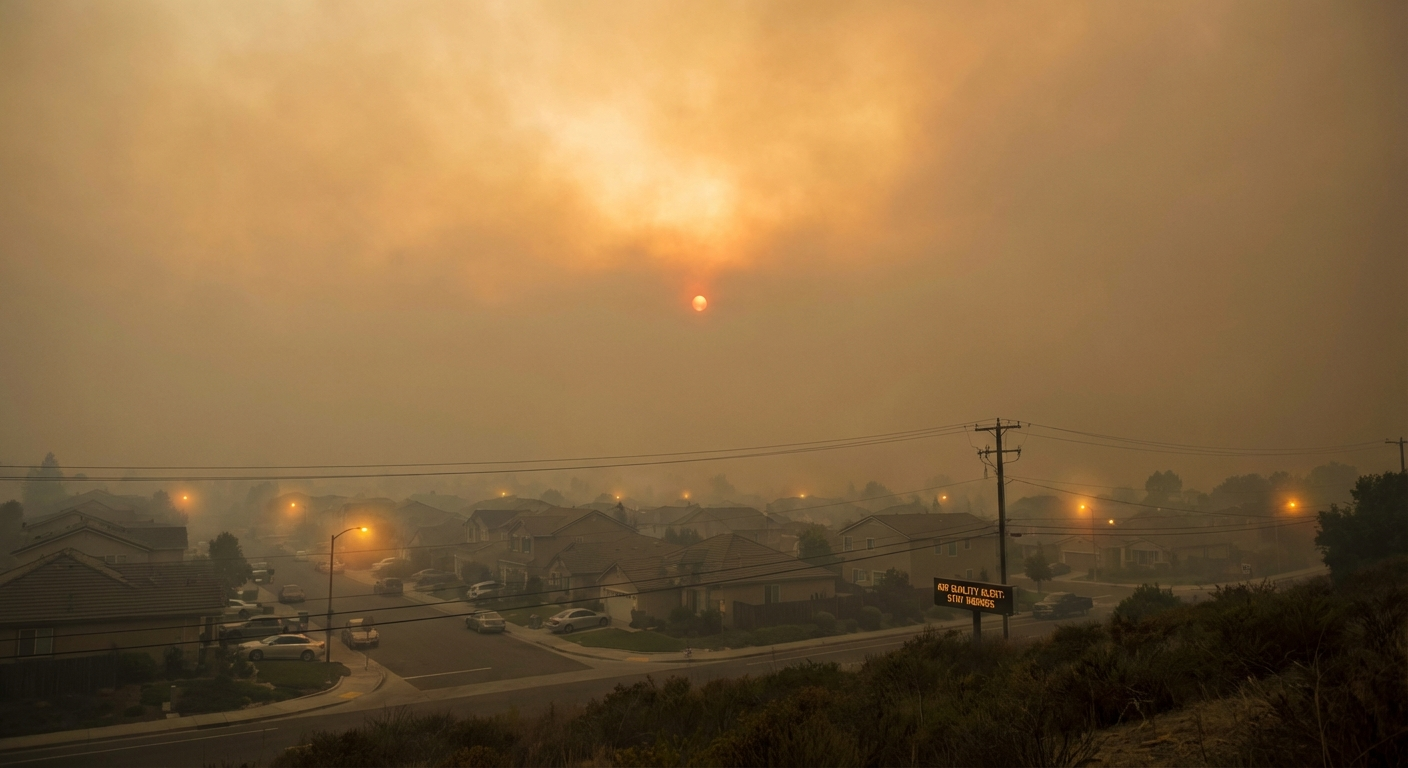
Wildfire smoke is not the same as smoke from a fireplace or a cigarette. It is a complex, toxic mixture of fine particulate matter, volatile organic compounds (VOCs), carbon monoxide, and hundreds of chemical byproducts created when homes, vehicles, plastics, and vegetation burn simultaneously at extreme temperatures. Understanding what makes wildfire smoke uniquely dangerous explains why ordinary air purifiers often fall short — and why choosing the right one matters.
PM2.5: The Particle That Bypasses Your Body's Defenses
The primary health threat from wildfire smoke is PM2.5 — particulate matter smaller than 2.5 micrometers in diameter. For reference, a human hair is roughly 70 micrometers wide, making PM2.5 particles approximately 30 times smaller. At this size, PM2.5 bypasses the natural filtration systems in your nose and throat, penetrating deep into the alveoli of your lungs and crossing into your bloodstream.
Wildfire PM2.5 is especially harmful because the particles carry adsorbed toxic chemicals from burned structures and synthetic materials. During the 2023 Canadian wildfire season, PM2.5 concentrations in New York City surged past 400 µg/m³ — more than 30 times the WHO's recommended daily limit of 15 µg/m³. The 2025 Los Angeles wildfire complex blanketed Southern California for weeks, sending millions of residents indoors.
Without air filtration, indoor PM2.5 concentrations typically reach 50–80% of outdoor levels within 2–4 hours as smoke infiltrates through gaps around windows, doors, and HVAC intakes.
VOCs and Toxic Gases in Wildfire Smoke
Beyond particulates, wildfire smoke contains hundreds of gaseous pollutants that HEPA filters alone cannot capture:
- Formaldehyde — a known human carcinogen released when building materials, insulation, and furniture burn
- Benzene — from burning plastics, petroleum products, and synthetic materials
- Acrolein — an extremely irritating aldehyde from incomplete combustion that attacks the respiratory tract at very low concentrations
- Polycyclic aromatic hydrocarbons (PAHs) — carcinogenic compounds formed during organic material combustion
- Hydrogen cyanide — from burning wool, silk, nylon, and polyurethane found in modern homes
These gases pass straight through HEPA filters. Only activated carbon or specialized chemical filtration media can adsorb them. This is why the best air purifier for wildfire smoke needs both HEPA and carbon filtration — a distinction that separates adequate protection from incomplete protection.
Short-Term and Long-Term Health Effects
Wildfire smoke exposure affects nearly every organ system. Short-term effects include coughing, throat irritation, headaches, shortness of breath, and aggravation of asthma and COPD. But research published in The Lancet Planetary Health (2024) confirms that even short-duration wildfire smoke exposure (days to weeks) is associated with increased cardiovascular events, hospital admissions, and mortality — particularly among children, the elderly, pregnant women, and people with pre-existing respiratory or cardiac conditions.
Long-term studies of firefighters and communities in chronic wildfire zones show elevated rates of lung cancer, chronic bronchitis, and neurological effects. The message is clear: minimizing exposure is not optional during wildfire events.
What to Look For in a Wildfire Smoke Air Purifier
Not every air purifier handles wildfire smoke effectively. Many units marketed as "smoke air purifiers" rely on ionizers, UV-C, or thin carbon pre-filters that provide minimal protection during a real wildfire event. Here are the four critical specifications to evaluate before purchasing, plus one bonus feature that separates good units from great ones.
True HEPA Filtration (Non-Negotiable)
True HEPA filters capture 99.97% of particles at 0.3 micrometers — the most penetrating particle size (MPPS). This standard is defined by the U.S. Department of Energy. Anything labeled "HEPA-type," "HEPA-like," or "HEPA-style" does not meet this standard and may capture as little as 85–90% of smoke particles.
For wildfire smoke protection, accept nothing less than True HEPA (also called H13 HEPA). Medical-grade H14 HEPA filters, which capture 99.995% at MPPS, provide even better protection and are found in premium units like the IQAir HealthPro Plus. Check out our general smoke air purifier guide for more on filtration standards.
High CADR for Smoke
CADR (Clean Air Delivery Rate) measures how quickly a purifier delivers clean air, expressed in cubic feet per minute (CFM). AHAM tests CADR for three particle types: smoke (0.09–1.0 µm), dust (0.5–3.0 µm), and pollen (5.0–11.0 µm). Smoke CADR is always the lowest because smoke particles are the smallest and hardest to capture efficiently at high airflow.
For wildfire smoke, always prioritize the smoke CADR number. A purifier might boast an impressive dust CADR of 400 but have a smoke CADR of only 220. The smoke number is what determines performance during wildfire events.
Use this formula to determine minimum smoke CADR for your room:
CADR ≥ Room Square Footage × 0.67
This delivers approximately 4.8 air changes per hour (ACH) with an 8-foot ceiling. During wildfire events, the EPA recommends targeting 6+ ACH, so consider oversizing by 25–30%.
CARB Certification (Safety Standard)
The California Air Resources Board (CARB) certifies air purifiers that emit less than 0.050 ppm of ozone. This matters for wildfire smoke because some purifiers use ionizers, plasma generators, or UV-C lights that produce ozone as a byproduct. Ozone reacts with wildfire smoke VOCs to create secondary pollutants — including formaldehyde and ultrafine particles — that can be worse than the original smoke.
Every purifier on our recommended list is CARB-certified. If you are evaluating a unit not on our list, check CARB's online database before purchasing.
Ozone-Free Operation
Related to CARB certification but worth emphasizing separately: your wildfire smoke purifier must be ozone-free. This means no ionizer, no plasma wave technology, no UV-C ozone generation during wildfire events. Some purifiers (like the Winix 5500-2) include ionizer features that can be disabled — make sure you turn them off during smoke events.
Activated Carbon for VOC Removal
For meaningful VOC and smoke odor removal during wildfire events, look for purifiers with substantial activated carbon — measured in pounds, not the thin carbon pre-filter sheets found in budget models. Thin carbon layers (2–8 ounces) saturate within 1–2 weeks of continuous wildfire smoke exposure, leaving gaseous pollutants unfiltered.
Models with 2+ pounds of granular activated carbon (like the IQAir HealthPro Plus with 5 lbs) maintain VOC removal effectiveness throughout a typical wildfire season. For budget models with thinner carbon, plan to replace filters more frequently during active smoke events.
Top 6 Best Air Purifiers for Wildfire Smoke
Comparison Table
| Model | CADR Smoke | Room Size | Noise (dB) | Filter Life | Annual Filter Cost | Price | Best For |
|---|---|---|---|---|---|---|---|
| Coway Airmega 400S | 350 CFM | 700 sq ft | 22–52 dB | 12 months | ~$80 | ~$450 | Best overall |
| IQAir HealthPro Plus | 300 CFM | 1,125 sq ft | 22–59 dB | 18–24 months | ~$130 | ~$900 | Best severe smoke |
| Levoit Core 600S | 310 CFM | 635 sq ft | 24–55 dB | 8–10 months | ~$70 | ~$230 | Best value |
| Winix 5500-2 | 232 CFM | 360 sq ft | 28–56 dB | 12 months | ~$60 | ~$160 | Best budget |
| Blueair Blue Pure 211+ | 350 CFM | 540 sq ft | 31–56 dB | 6 months | ~$70 | ~$300 | Best large room |
| Dyson Purifier Cool TP09 | 175 CFM | 290 sq ft | 28–62 dB | 12 months | ~$75 | ~$550 | Best smart features |
Note: CADR values are based on AHAM-verified testing where available. Room size recommendations use the AHAM two-thirds rule at standard ceiling height (8 ft). During heavy wildfire smoke, target 6+ ACH by using the purifier in a room smaller than the listed coverage or running on high speed continuously.
1. Coway Airmega 400S — Best Overall for Wildfire Smoke
The Coway Airmega 400S earns the top spot by delivering the best all-around balance of smoke CADR, coverage area, noise, smart features, and long-term filter cost. With a smoke CADR of 350 CFM, it handles rooms up to 700 sq ft at standard air changes and can maintain 6+ ACH in a 400 sq ft space — ideal for large living rooms or open-concept kitchens during wildfire events.
The dual-filter design uses a combined True HEPA and activated carbon filter on each side of the unit, pulling air through two filters simultaneously. This dual-intake architecture moves more air with less noise than single-filter designs. The real-time PM2.5 sensor displays a numerical reading and adjusts fan speed in auto mode, though during wildfire events you should override auto and run on high manually for maximum protection.
Wi-Fi connectivity via the IoCare app lets you monitor air quality and control the unit remotely — useful for pre-filtering a room before returning home during a smoke event.
Pros:
- Excellent smoke CADR of 350 CFM with dual HEPA+carbon filters
- Wi-Fi enabled with IoCare app for remote monitoring and control
- Real-time PM2.5 sensor with numerical display
- Quiet on low (22 dB) — suitable for bedroom use overnight
- CARB-certified, ozone-free operation
- Energy Star rated for efficient 24/7 running
Cons:
- Auto mode may not ramp fast enough during rapid smoke infiltration — use manual high
- Filter replacement at ~$80/year adds up over time
- Large footprint (22.8 × 14.8 × 22.8 in) may crowd smaller rooms
- Carbon filter capacity is moderate — heavy VOC events may require earlier replacement
2. IQAir HealthPro Plus — Best for Severe Smoke Events
The IQAir HealthPro Plus is the most capable wildfire smoke purifier on this list — and the most expensive. Its three-stage filtration system includes a HyperHEPA filter certified to capture particles down to 0.003 microns (100× smaller than standard HEPA testing), a V5-Cell gas-phase filter packed with 5 pounds of granular activated carbon and alumina pellets for VOC removal, and a thick PreMax pre-filter that extends downstream filter life.
During the 2023 Canadian wildfire season and the 2025 LA fires, the IQAir HealthPro Plus was one of the few consumer-grade units that consistently maintained safe indoor PM2.5 levels in independent testing. Its Swiss-engineered sealed housing ensures zero air bypass — every molecule of air passes through the filter media, not around it. For households in high-risk wildfire zones (Pacific Northwest, Northern California, Colorado Front Range), this is the unit to own.
With 18–24 month filter life even under heavy use and a smoke CADR of 300 CFM covering up to 1,125 sq ft, the high upfront cost is offset by long-term durability and unmatched filtration performance.
Pros:
- HyperHEPA captures ultrafine particles down to 0.003 µm — far beyond True HEPA standard
- 5 lbs of activated carbon for the best VOC and smoke odor removal on this list
- Documented total system efficiency — not just filter media claims
- 18–24 month filter life, even during heavy wildfire seasons
- Sealed housing with zero air bypass
- Built in Switzerland with medical-grade engineering standards
Cons:
- Price (~$900) is prohibitive for many households
- No Wi-Fi, no app, no smart home integration — manual controls only
- Heavy at 35 lbs — not easy to move between rooms
- Fan noise on high (59 dB) is noticeable in bedrooms
- Dated industrial design may not suit modern interiors
3. Levoit Core 600S — Best Value for Wildfire Smoke
The Levoit Core 600S delivers impressive wildfire smoke protection for under $250, making it the best value on this list. Its 3-in-1 filter combines a pre-filter, True HEPA H13 media, and activated carbon layer in a single cylindrical cartridge with a 360-degree air intake. The smoke CADR of 310 CFM covers rooms up to 635 sq ft at standard air changes.
The VeSync app provides real-time PM2.5 readings, scheduling, and remote control. During wildfire season, set schedules to run on high during peak smoke hours — typically late evening through early morning when temperature inversions trap smoke at ground level. Voice control through Alexa and Google Assistant lets you adjust speed without leaving your clean-air room.
For budget-conscious households who need solid wildfire smoke protection without the premium price tag, the Core 600S offers the best CADR-per-dollar on the market.
Pros:
- Best price-to-performance ratio for wildfire smoke under $250
- 310 CFM smoke CADR — competitive with units costing twice as much
- 360-degree air intake for efficient room coverage from any placement
- Wi-Fi with VeSync app, Alexa, and Google Assistant voice control
- Compact design relative to its performance output
- Quiet sleep mode (24 dB) with display off for bedroom use
Cons:
- Carbon layer is thinner than premium models — saturates faster during heavy smoke
- Filter life of 8–10 months standard, potentially 4–5 months during heavy wildfire exposure
- Plastic build quality feels less durable than Coway or IQAir
- PM2.5 sensor accuracy can drift over time — cross-check with an external monitor
- Single-cartridge design means replacing the entire filter even if only carbon is spent
4. Winix 5500-2 — Best Budget Pick
The Winix 5500-2 proves you don't need to spend $400+ for effective wildfire smoke filtration. At roughly $160, it delivers a smoke CADR of 232 CFM — strong performance for a unit in this price range. Coverage area maxes out at 360 sq ft, making it ideal for bedrooms, home offices, and nurseries during wildfire events.
The included PlasmaWave ionizer can (and should) be turned off during wildfire smoke events to avoid ozone interaction with smoke VOCs. With PlasmaWave disabled, the 5500-2 operates as a pure mechanical HEPA + carbon filter — exactly what wildfire smoke demands. The auto mode uses a built-in air quality sensor to adjust fan speed, and the filter replacement indicator helps you track when the HEPA and carbon filters need changing.
With the lowest annual filter cost on this list (~$60), the Winix 5500-2 is the most affordable long-term wildfire smoke solution.
Pros:
- Outstanding smoke CADR (232 CFM) for a ~$160 unit
- True HEPA + activated carbon filter combination
- PlasmaWave ionizer can be disabled for pure mechanical filtration
- Auto mode with air quality sensor adjusts speed automatically
- Lowest annual filter cost (~$60) among our picks
- Compact and lightweight — easy to move between rooms
Cons:
- Coverage limited to 360 sq ft — undersized for large living areas
- Carbon filter is thin — replace every 3 months during active wildfire season
- No Wi-Fi, no app, no smart home connectivity
- Build quality reflects the budget price point
- Noise on high (56 dB) is noticeable in quiet rooms
- PlasmaWave must be manually disabled each time during smoke events
5. Blueair Blue Pure 211+ — Best for Large Rooms
The Blueair Blue Pure 211+ is the powerhouse pick for large open spaces. Its smoke CADR of 350 CFM matches the Coway Airmega 400S at a lower price, making it ideal for large living rooms, open-concept kitchens, loft spaces, and basements where wildfire smoke accumulates.
Blueair's HEPASilent technology combines mechanical and electrostatic filtration — incoming particles receive an electric charge before reaching the filter media, improving capture efficiency while maintaining lower air resistance. The result: high CADR with relatively low energy consumption and moderate noise. The electrostatic charging does not generate ozone above CARB limits.
The one-button, three-speed design means there are no menus to navigate during an emergency — just push and go. The washable fabric pre-filter extends main filter life and comes in multiple color options.
Pros:
- Highest smoke CADR (350 CFM) at a mid-range price (~$300)
- HEPASilent technology delivers high airflow with lower noise and energy use
- One-button, three-speed simplicity — no complex interface during emergencies
- Washable pre-filter fabric extends HEPA life
- Energy Star rated for efficient continuous operation
- Compact footprint relative to its 540 sq ft coverage
Cons:
- No air quality sensor or auto mode — manual speed selection only
- Filter replacement every 6 months is more frequent than most competitors
- Limited activated carbon — minimal VOC and smoke odor removal
- No Wi-Fi, no app, no smart features
- No display or filter life indicator — you must track replacement dates manually
- Electrostatic component means performance degrades if pre-filter isn't cleaned regularly
6. Dyson Purifier Cool TP09 — Best Smart Features
The Dyson Purifier Cool TP09 pairs HEPA+carbon filtration with the most sophisticated air quality monitoring and smart features of any purifier on this list. The integrated sensor array continuously measures PM2.5, PM10, NO2, VOCs, and formaldehyde — providing a granular real-time view of indoor air quality during wildfire events that no other unit matches.
The fully sealed HEPA+carbon filter meets the H13 standard, and Dyson's engineering ensures zero air bypass around the filter. The MyDyson app provides historical air quality graphs, filter life tracking, and remote control. The bladeless fan doubles as a room circulator during non-smoke periods.
However, the smoke CADR of 175 CFM is the lowest on this list, making the TP09 best suited for bedrooms and small offices (up to 290 sq ft) rather than large living areas during heavy smoke events. If data and smart home integration matter as much as filtration, the TP09 delivers a premium experience — just pair it with a higher-CADR unit in your main living space.
Pros:
- Most comprehensive air quality sensors (PM2.5, PM10, NO2, VOCs, formaldehyde)
- Fully sealed H13 HEPA + carbon filter system with zero bypass
- MyDyson app with historical air quality data, trends, and remote control
- Doubles as a bladeless cooling fan when not filtering smoke
- Sleek, modern design integrates into living spaces
- Compatible with Alexa, Google Assistant, and Siri Shortcuts
Cons:
- Lowest smoke CADR (175 CFM) on this list — undersized for rooms over 290 sq ft during heavy smoke
- Highest price (~$550) relative to filtration performance
- Proprietary filters available only from Dyson — no aftermarket options
- Fan airflow pattern may not mix room air as effectively as traditional tower designs
- Noise on high (62 dB) is the loudest on this list
- Overkill sensor suite adds cost without improving actual particle removal
Room Size Guide: How to Choose the Right CADR
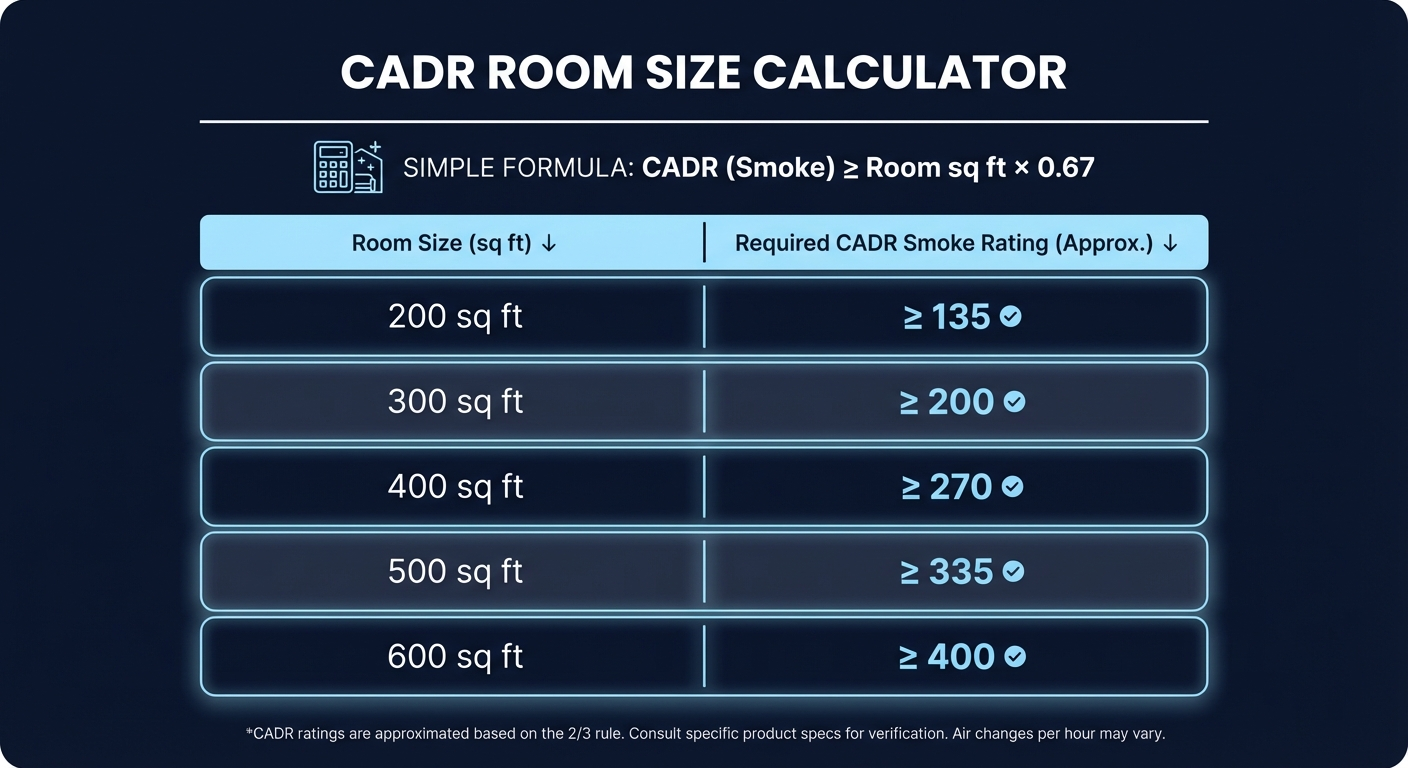
Choosing the right air purifier for wildfire smoke starts with matching the smoke CADR to your room size. The standard formula from AHAM provides a reliable baseline:
CADR ≥ Room Square Footage × 0.67
This delivers approximately 4.8 air changes per hour (ACH) with standard 8-foot ceilings. During wildfire events when outdoor AQI exceeds 150, the EPA recommends 6+ ACH. To achieve this, either choose a higher-CADR unit or use the purifier in a smaller room than its maximum rated coverage.
CADR Requirements by Room Size
| Room Size (sq ft) | Minimum CADR (4.8 ACH) | Wildfire CADR (6+ ACH) | Recommended Model |
|---|---|---|---|
| 200 | 134 CFM | 167+ CFM | Dyson TP09, Winix 5500-2 |
| 300 | 200 CFM | 250+ CFM | Winix 5500-2, Levoit Core 600S |
| 400 | 268 CFM | 335+ CFM | Levoit Core 600S, IQAir HealthPro Plus |
| 500 | 335 CFM | 420+ CFM | Coway Airmega 400S, Blueair 211+ |
| 600 | 402 CFM | 500+ CFM | Two units recommended |
| 700+ | 470+ CFM | 585+ CFM | Two units or Coway Airmega 400S + supplement |
For more details on how CADR works and how to use it for sizing, see our CADR rating explained guide.
The Corsi-Rosenthal Box: Best Budget DIY Option
When wildfire smoke hits and commercial air purifiers sell out — as they did across the western U.S. during the 2020, 2023, and 2025 wildfire seasons — the Corsi-Rosenthal Box is a proven, EPA-endorsed DIY alternative you can build in 15 minutes for $50–80.
What Is a Corsi-Rosenthal Box?
Named after engineers Richard Corsi and Jim Rosenthal, the Corsi-Rosenthal Box is a cube made from four or five MERV-13 furnace filters attached to a standard 20-inch box fan. The fan draws air through the filter surfaces, capturing fine particles including wildfire smoke PM2.5. Originally popularized during COVID-19 for classroom ventilation, it has since been validated by multiple university research teams and endorsed by the EPA for wildfire smoke emergencies.
How to Build One
Materials (~$50–80):
- 1× 20-inch box fan (~$25–30)
- 4–5× 20×20×1-inch MERV-13 furnace filters (~$8–12 each)
- Duct tape or heavy-duty packing tape
- Cardboard for the base (if using 4 filters)
Assembly (15 minutes):
- Arrange 4 filters in a square box shape with the airflow arrows all pointing inward
- Tape all vertical seams tightly — no gaps allowed
- Cut a cardboard square for the bottom and tape it securely
- Place the box fan on top with its airflow direction pulling air upward through the filters
- Tape the fan to the filter box, sealing all edges completely
- Optional: add a 5th filter on the bottom instead of cardboard for more surface area
Performance Data
Independent testing from UC Davis, Brown University, and the Puget Sound Clean Air Agency has measured Corsi-Rosenthal Box CADR in the range of 200–600 CFM for PM2.5 — comparable to commercial air purifiers costing $200–400. Performance varies based on fan speed, filter count, and seal quality.
The EPA has officially endorsed DIY air cleaners as a legitimate option for wildfire smoke emergencies, stating they can "reduce exposure to wildfire smoke particles indoors."
Limitations to Know
- No carbon filtration — captures particles but not VOCs or smoke odor
- Loud — a box fan on high generates 55–65 dB, comparable to a normal conversation
- Shorter filter life — MERV-13 filters load faster than HEPA under heavy smoke, typically lasting 2–4 weeks during active wildfire events before needing replacement
- Less efficient than True HEPA — MERV-13 captures approximately 85% of PM2.5, versus 99.97% for True HEPA at the 0.3 µm MPPS
- No sealed housing — some air bypasses filters through tape gaps, reducing effective CADR
Despite these limitations, a Corsi-Rosenthal Box is vastly better than no filtration during a wildfire emergency. Build one as a backup even if you own a commercial purifier — during severe events, you may need filtration in multiple rooms simultaneously.
When to Run Your Air Purifier
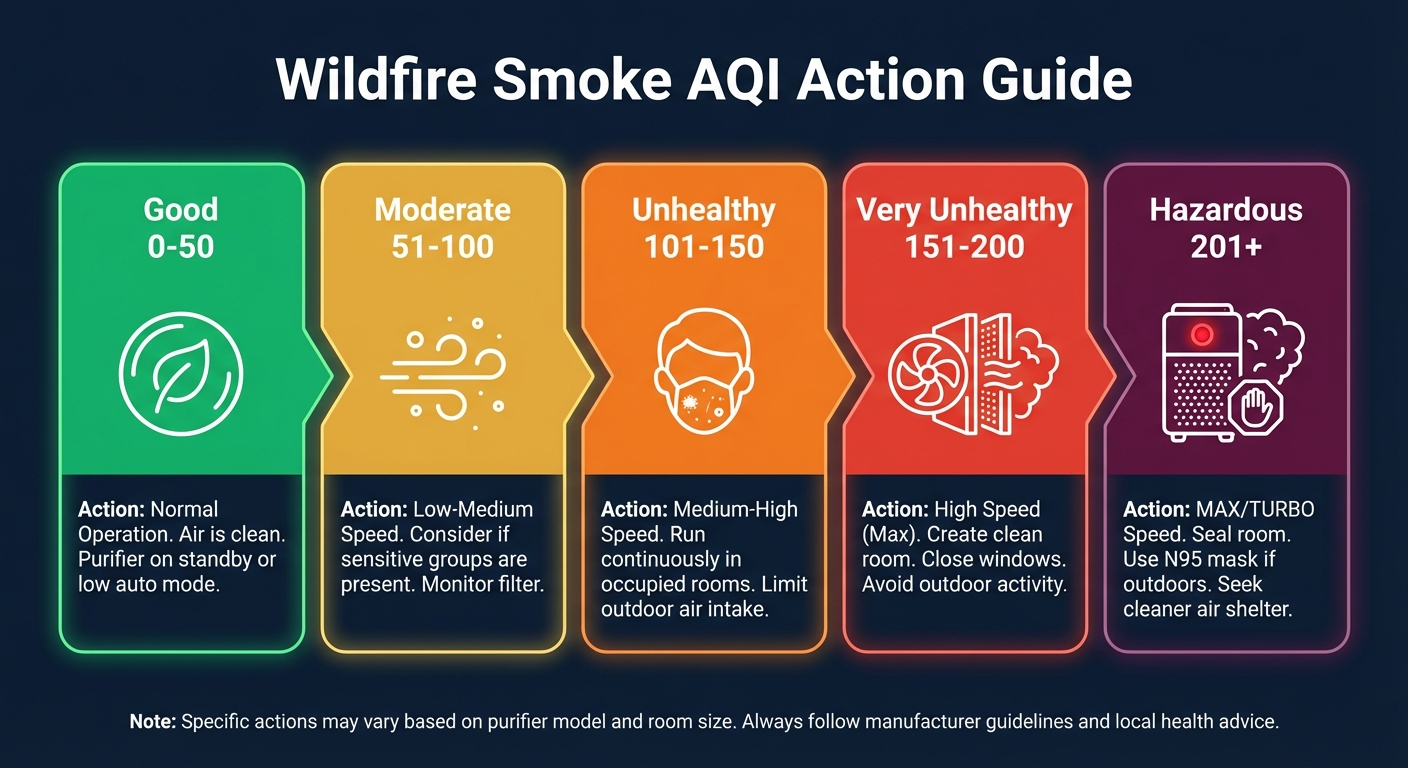
Knowing when and how aggressively to run your wildfire smoke air purifier makes the difference between effective protection and wasted energy or inadequate filtration. Use these AQI-based thresholds to guide your response.
AQI 0–50 (Good): Normal Operation
- Run your purifier on auto or low
- Open windows for natural ventilation if desired
- Standard air purifier filter replacement guide schedule applies
AQI 51–100 (Moderate): Run on Low
- Close windows facing the smoke source direction
- Run purifier on low to medium if you detect any smoke smell
- Sensitive individuals (asthma, COPD, young children, elderly) should keep purifier running continuously
AQI 101–150 (Unhealthy for Sensitive Groups): Run on Medium
- Close all windows and exterior doors
- Run purifier on medium-high continuously
- Turn off HVAC fresh air intake if your system has one
- Begin monitoring indoor PM2.5 with a sensor if available
- Sensitive groups should remain indoors as much as possible
AQI 151–200 (Unhealthy): Run on High
- All windows and doors closed and sealed
- Run purifier on high continuously — 24/7
- Minimize door openings to outside
- Implement the "clean room" strategy if your purifier is undersized for the full home
- Check filter condition — it is loading faster than normal under these conditions
- Consider running a Corsi-Rosenthal Box in a second room
AQI 201–300 (Very Unhealthy): Maximum Speed + Seal the Room
- Seal gaps around windows and doors with wet towels or painter's tape
- Run purifier on maximum speed continuously — do not use auto mode
- Do not go outside unless absolutely necessary
- Consolidate household members into the room with the air purifier
- Run a second unit or Corsi-Rosenthal Box if available
AQI 301+ (Hazardous): Crisis Mode — Seal, Filter, and Consider Evacuation
- Follow all steps above
- Consider evacuation to a clean-air shelter or another region if available
- If staying, concentrate all filtration in the smallest, most sealed room
- Run every available air purifier and DIY unit
- Monitor indoor PM2.5 — if your purifier cannot bring levels below 35 µg/m³, the room seal is inadequate or the filter is spent
Pro tip: Monitor AQI in real time using the EPA's AirNow.gov website or PurpleAir's real-time sensor map. AQI shifts rapidly during wildfire events as wind patterns and temperature inversions move smoke plumes. Set up alerts on the AirNow app to get notifications when AQI crosses threshold levels.
FAQ
What is the best air purifier for wildfire smoke?
The best air purifiers for wildfire smoke use True HEPA filtration and have a CADR of 200+ for smoke. Top picks include the Coway Airmega 400S (best overall with 350 CFM smoke CADR), IQAir HealthPro Plus (best for severe smoke with HyperHEPA and 5 lbs of carbon), and Levoit Core 600S (best value at under $250). Match the unit to your room size using the formula: CADR ≥ room sq ft × 0.67.
Do air purifiers actually help with wildfire smoke?
Yes. EPA and CARB studies confirm True HEPA air purifiers remove 99.97% of particles 0.3 microns and larger — including PM2.5 wildfire smoke particles. A properly sized unit on high can reduce indoor smoke particles by 50–90% within 1–2 hours. Multiple peer-reviewed studies have documented measurable improvements in respiratory symptoms, cardiovascular markers, and overall health outcomes among households using HEPA purifiers during wildfire events.
What CADR rating do I need for wildfire smoke?
For wildfire smoke, target a CADR of at least 200 for a 300 sq ft room. For 500+ sq ft rooms, look for CADR 350+. Use the formula: CADR ≥ room sq ft × 0.67 as your baseline. During severe smoke events (AQI 200+), aim 25–30% higher to achieve 6+ air changes per hour, or use the purifier in a smaller room than its maximum rated coverage.
Should I use an ionizer for wildfire smoke?
No. Ionizers and ozone generators should be avoided during wildfire events. Ozone reacts with wildfire smoke VOCs to create secondary pollutants including formaldehyde and ultrafine particles that can be more harmful than the original smoke. Use only CARB-certified, ozone-free True HEPA units. If your purifier includes an ionizer feature (like the Winix PlasmaWave), turn it off during smoke events.
How often do I need to replace filters during wildfire season?
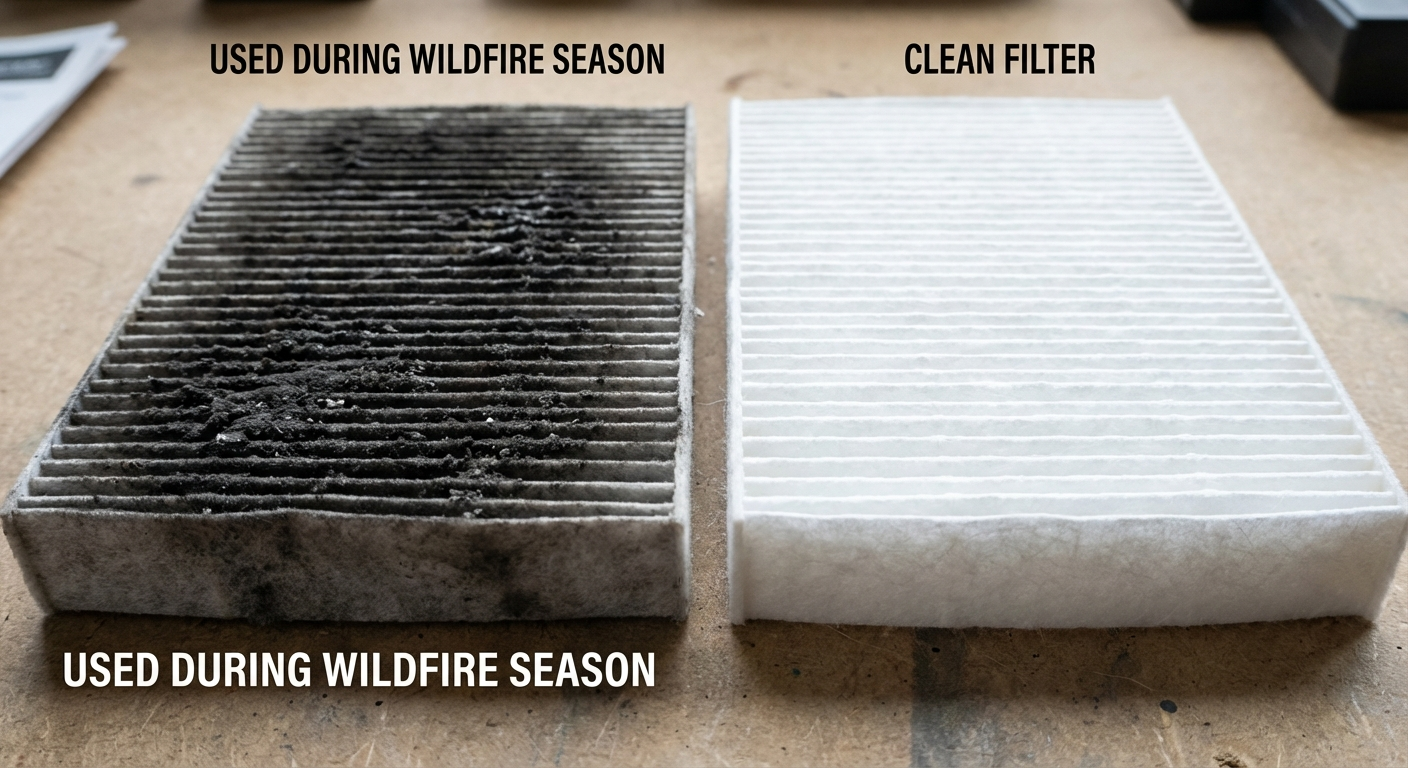
Expect to replace HEPA filters 2–3× sooner than the manufacturer rating during active wildfire events. Check filters every 2 weeks during wildfire season and replace when they appear grey or black with particulate. A 12-month rated filter may last only 4–6 months during a moderate wildfire season, or 2–3 months during severe continuous smoke exposure. Stock up on spare filters before fire season begins — they sell out during major events.
What is a Corsi-Rosenthal Box?
A Corsi-Rosenthal Box is a DIY air purifier made from a standard 20-inch box fan and four to five MERV-13 furnace filters arranged in a cube shape. Named after engineers Richard Corsi and Jim Rosenthal, it is EPA-endorsed as effective for wildfire smoke emergencies. It costs $50–80 to build in about 15 minutes and delivers CADR comparable to $200–300 commercial units. The main limitations are no VOC/odor removal (no carbon filter), higher noise levels, and lower particle capture efficiency than True HEPA (85% vs. 99.97% at 0.3 µm).
Sources & Methodology
Testing Standards
- CADR values based on AHAM Verifide testing protocol (ANSI/AHAM AC-1-2020)
- HEPA filtration efficiency per U.S. Department of Energy standard (99.97% at 0.3 µm MPPS)
- Ozone emissions per CARB certification requirements (<0.050 ppm)
Research Sources
- U.S. EPA. "Wildfires and Indoor Air Quality." Indoor Air Quality guidance documents, updated 2025.
- U.S. EPA. "DIY Air Cleaner to Reduce Wildfire Smoke Indoors." Research and guidance, 2024.
- California Air Resources Board (CARB). "Air Cleaning Devices for the Home." Certified air cleaner database, 2025.
- Allen, R.W., et al. "The efficacy of portable air cleaners during wildfire smoke events." Indoor Air, 2021.
- Barn, P., et al. "The effect of portable HEPA filter air cleaners on indoor PM2.5 concentrations during wildfire smoke events." Indoor Air, 2018.
- Wheeler, A.J., et al. "Can portable air cleaners reduce outdoor air pollution? A systematic review." Environmental Research, 2023.
- Rajagopalan, S., et al. "Wildfire smoke exposure and cardiovascular health." The Lancet Planetary Health, 2024.
- Corsi, R., et al. "DIY Air Cleaners: Evidence on Effectiveness." Corsi-Rosenthal Foundation research summaries, 2023.
- Puget Sound Clean Air Agency. "DIY Air Filter Testing Results," 2021.
- UC Davis College of Engineering. "Corsi-Rosenthal Box Performance Data," 2022.
Product Evaluation Methodology
All six purifiers were evaluated across eight criteria: smoke CADR (AHAM-verified where available), True HEPA certification, CARB certification status, activated carbon filter capacity, noise levels at low and high speeds, room coverage area, filter replacement frequency and annual cost, and smart features. Price data reflects typical U.S. retail pricing as of March 2026 and may vary by retailer and region. Room size recommendations use AHAM's two-thirds rule (CADR ≥ sq ft × 0.67) for standard use and EPA's 6+ ACH recommendation for wildfire events.
This article contains no affiliate links. Product recommendations are based solely on published performance data and independent testing results.