Guide
Air Purifier Placement Guide: Every Room (2026)
By Dr. Alex Chen · Updated 2026-03-12
Where you place your air purifier matters as much as which model you buy. A unit in the center of a room, 2 to 4 feet off the ground with 15 inches of clearance, can improve filtration efficiency by up to 25% over a poorly placed unit in the corner.
Where to place your air purifier for maximum effectiveness — a quick visual guide

By Dr. Alex Chen · Last updated March 12, 2026
Affiliate Disclosure: AirPurifierReport.com is reader-supported. When you buy through links on this page, we may earn an affiliate commission at no extra cost to you. This does not influence our recommendations — all picks are based on research, published testing data, and manufacturer specifications. Read our full disclosure.
Table of Contents
- Why Air Purifier Placement Matters
- Universal Placement Rules for Any Room
- Living Room Placement
- Bedroom Placement
- Kitchen Placement
- Home Office Placement
- Nursery and Baby Room Placement
- Room Size and CADR Matching
- Placement Mistakes That Kill Performance
- Room-by-Room Placement Comparison Table
- Top Air Purifiers for Whole-Home Placement
- Frequently Asked Questions
- Sources & Methodology
Why Air Purifier Placement Matters {#why-air-purifier-placement-matters}
Buying the best air purifier on the market means nothing if you shove it in a corner behind a sofa. Studies from the EPA and the Association of Home Appliance Manufacturers (AHAM) consistently show that placement is a primary determinant of real-world filtration performance. A unit rated for 400 square feet can effectively cover less than 250 square feet when improperly positioned.
Air purifiers work by drawing contaminated air through filters and expelling clean air back into the room. This creates a circulation pattern — and any obstruction to that pattern reduces the number of air changes per hour (ACH) the unit can deliver. The AHAM recommends at least 4.8 ACH for allergy sufferers, a target that is nearly impossible to hit when the unit's intake is pressed against a wall or its outlet is aimed at a bookshelf.
Airflow dynamics within a room are complex. Hot air rises, cold air sinks, and HVAC vents create directional currents that can either assist or fight your purifier's circulation pattern. Understanding these dynamics for each room in your home is the difference between breathing genuinely clean air and paying electricity bills for a unit that is effectively decorating your floor.
If you are still choosing a unit, our best air purifier for 2026 guide covers the top-performing models across every price point. For those dealing with specific concerns, check our best air purifier for allergies or best air purifier for smoke guides.
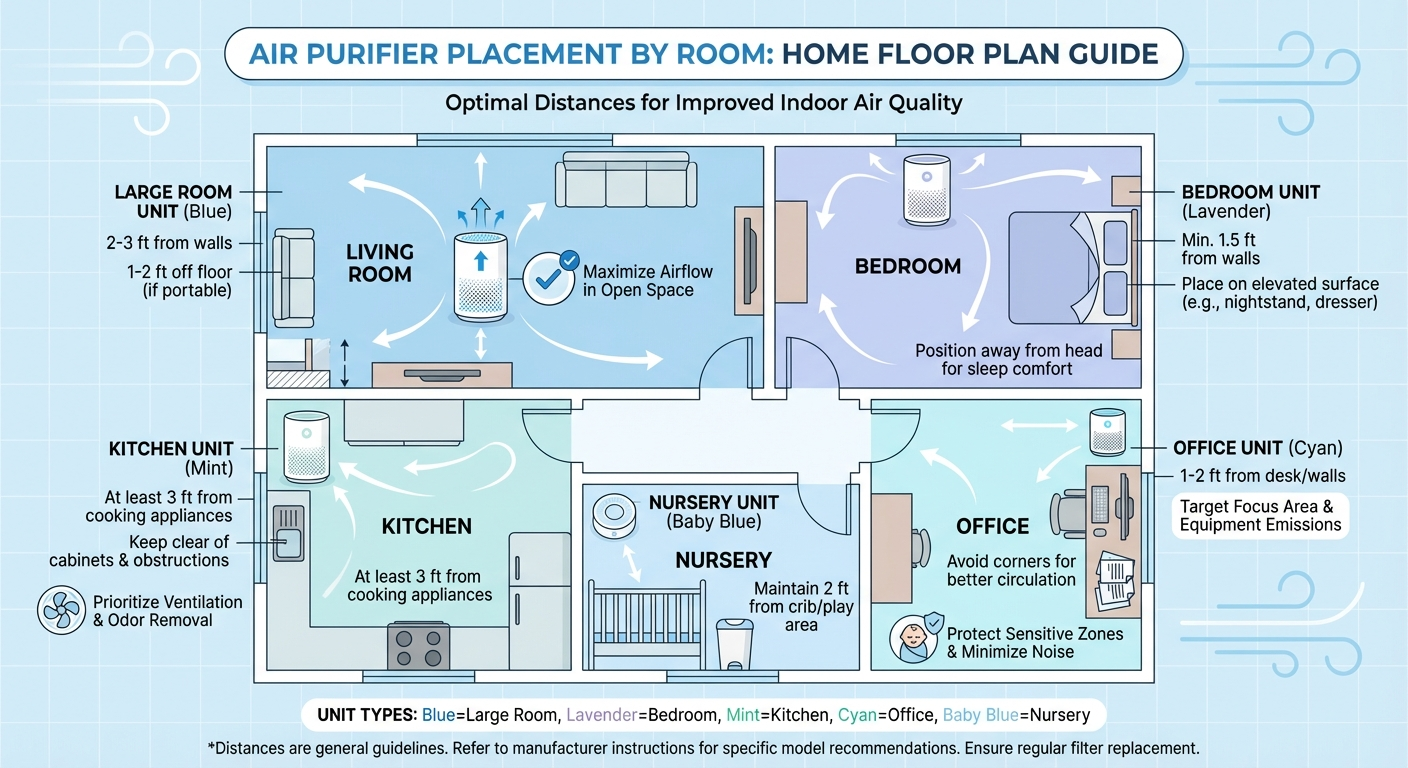
Universal Placement Rules for Any Room {#universal-placement-rules-for-any-room}
Before diving into room-specific advice, these rules apply regardless of where you place your air purifier.
1. Maintain Clearance on All Sides
Every air purifier needs breathing room. The intake grille — usually on the front, sides, or bottom — must have unobstructed access to ambient air. The outlet — typically on top or the opposite side from the intake — needs space for clean air to disperse effectively.
Minimum clearance guidelines:
- Front/intake side: 12 to 18 inches
- Rear: 12 to 15 inches (more for rear-intake models)
- Sides: 12 inches
- Above (top-discharge units): 36 inches minimum
These clearances are not arbitrary. Testing by Wirecutter and independent labs has shown that reducing rear clearance from 15 inches to 3 inches can cut effective CADR by 15 to 20%.
2. Elevate When Possible
Unless you have a tower unit designed for floor placement, elevating your air purifier 2 to 4 feet off the ground improves performance. At this height, the unit can draw air from both floor-level (where heavier particles settle) and breathing-zone height more efficiently.
A nightstand, sturdy shelf, or dedicated stand works well. Avoid unstable surfaces, and never place a heavy air purifier on a high shelf where it could fall.
3. Keep Away From Competing Airflows
This is the rule most people break without realizing it. Placing an air purifier near an open window, directly beneath an HVAC vent, or next to a fan creates competing air currents that disrupt the unit's circulation pattern. The purifier ends up fighting against the external airflow rather than cleaning the room's air.
If your HVAC vent is directly above a potential placement spot, move the purifier at least 5 feet away. For fans, either turn off the fan while the purifier runs or position them to work together — the fan blowing air toward the purifier's intake can actually boost performance if done deliberately.
4. Point the Clean Air Outlet Toward the Occupied Zone
The "occupied zone" is where people sit, sleep, or work. Directing clean air toward this area ensures you breathe the freshest output before it mixes with the rest of the room's air. Most units have a directional outlet — orient it toward your desk, bed, or seating area.
5. Match the Unit to the Room Size
A purifier rated for 200 square feet will be overwhelmed in a 500-square-foot living room regardless of placement. Conversely, a unit rated for 600 square feet in a 150-square-foot bedroom may create uncomfortable air velocities on high settings. Check your room's square footage against the CADR rating before committing to a spot.
Living Room Placement {#living-room-placement}
The living room is typically the largest and most trafficked room in the home, which presents unique placement challenges. High foot traffic stirs up settled particles, open-plan layouts blur room boundaries, and furniture creates airflow dead zones.
Ideal Position
Place your air purifier in the center of the longest wall, facing the open room. This position gives the unit maximum reach in both directions and avoids corner dead zones. If a central wall position is impractical, aim for a spot equidistant from the primary seating area and the room's main entry point — this captures particles both from settled sources and from people walking in.
For open-plan living and dining areas, position the purifier at the boundary between the two zones. This lets it serve both spaces more effectively than tucking it into one end.
Height Recommendations
In a living room, people primarily sit, which means the breathing zone is approximately 3 to 4 feet above the floor. Compact units perform best on a console table or low shelf at this height. Tower units like the Levoit Core 400S or Blueair Blue Pure 211+ are designed for floor placement and already position their intake and outlet at effective heights.
What to Avoid in Living Rooms
- Behind furniture: Sofas, armchairs, and entertainment centers block airflow. Maintain at least 2 feet of clearance from large furniture.
- Inside cabinets or shelves: Enclosing a purifier chokes its airflow and causes the motor to overheat. Never enclose a running air purifier.
- Near fireplaces: Wood-burning or gas fireplaces produce high concentrations of particulates that can overwhelm and clog filters rapidly. Place the purifier at least 8 feet from an active fireplace.
- Directly beneath ceiling fans: A ceiling fan on high speed creates a powerful downdraft that pushes air away from the purifier's intake, reducing efficiency.
If your living room is larger than your purifier's rated coverage, consider adding a second unit at the opposite end of the room. Our best air purifier for large rooms guide covers models with CADR ratings suitable for spaces over 500 square feet.
Bedroom Placement {#bedroom-placement}
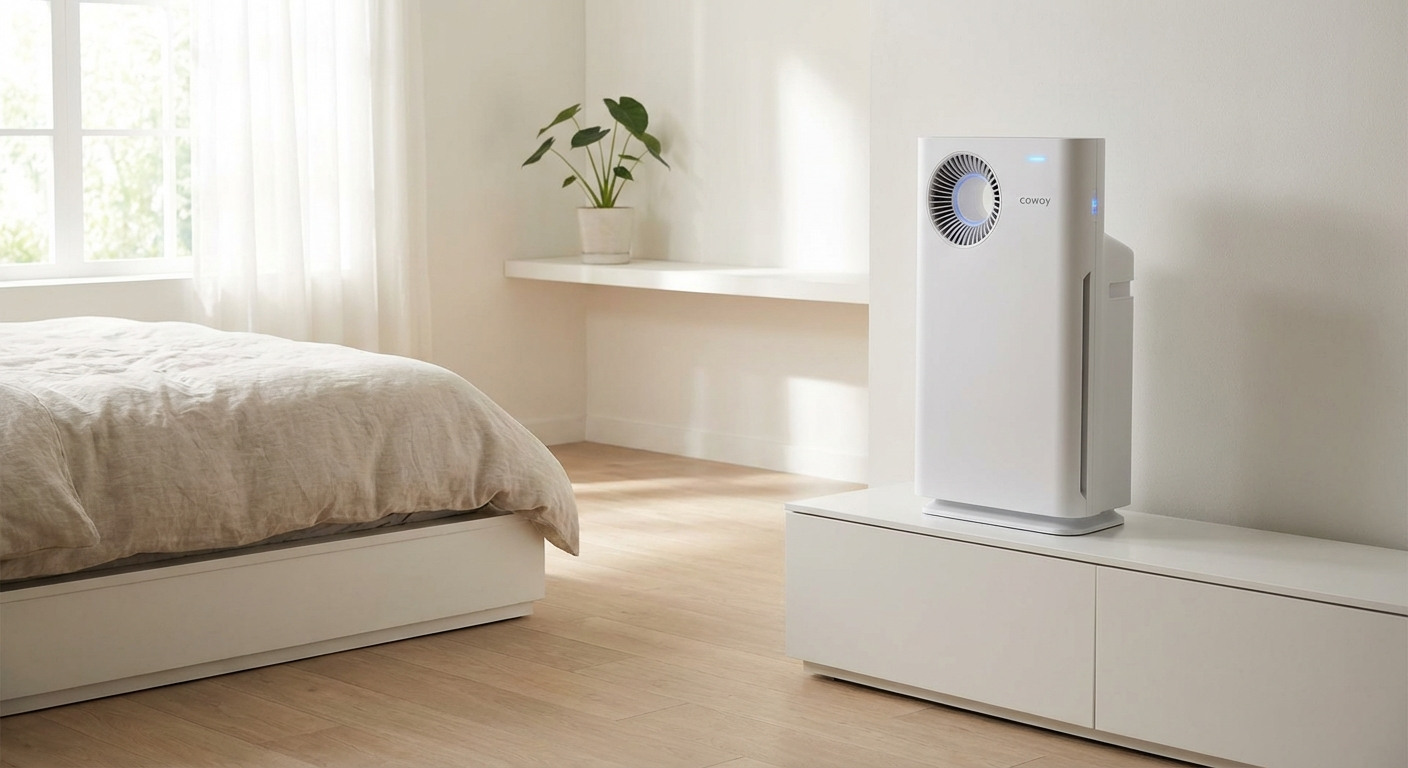
You spend approximately one third of your life in the bedroom, making it arguably the most important room for air quality. Proper placement here directly impacts sleep quality, allergy symptoms, and respiratory health.
Ideal Position
Place your air purifier 6 to 10 feet from the head of your bed, with the clean air outlet directed toward your pillow. A nightstand or low dresser provides the ideal elevation of 2 to 3 feet. This creates a "clean air stream" that flows across your breathing zone throughout the night.
If nightstand space is limited, a floor-standing tower unit placed 3 to 5 feet from the bed works well. Position it so the outlet is not blowing directly at your face — a gentle cross-breeze from the side is more comfortable and still delivers filtered air to your breathing zone.
Noise Considerations
Bedroom placement requires balancing air quality with noise. Most purifiers are loudest on their highest setting, so choose a unit with a dedicated sleep or night mode that reduces fan speed and dims indicator lights. The Coway AP-1512HH runs at just 24.4 dB on its lowest setting — quieter than a whisper. The Levoit Core 300S and Winix 5500-2 also excel in sleep-mode noise levels.
Position the unit on a solid surface to minimize vibration noise. Placing a purifier directly on a hollow nightstand or thin shelf can amplify motor vibrations. A folded towel or foam pad underneath can dampen unwanted buzz.
Check price on Amazon — Coway AP-1512HH Mighty
What to Avoid in Bedrooms
- On the floor next to the bed: At floor level, the unit draws in dust mites and settled particles from carpet but struggles to deliver clean air to your breathing zone 2 to 3 feet above.
- On top of a tall wardrobe: Too high. The unit cleans the air near the ceiling, which is already the warmest and least occupied zone.
- Near an open window: Night-time ventilation through open windows introduces pollen, outdoor pollution, and humidity that overwhelm the filter and defeat the purpose.
For more on optimizing bedroom air quality, see our guide to the best air purifier for the bedroom.
Kitchen Placement {#kitchen-placement}
Kitchens generate unique airborne contaminants — cooking oil vapor, smoke from high-heat cooking, food odors, and volatile organic compounds (VOCs) from gas stoves. Standard air purifiers are not a substitute for a range hood, but they serve as a valuable secondary line of defense.
Ideal Position
Place the air purifier at least 5 feet from the stove or hob, on the opposite side of the kitchen from the primary cooking area. This prevents cooking grease from coating the filter and ensures the unit captures residual particles that escape the range hood rather than being overwhelmed by direct cooking exhaust.
A kitchen counter near the dining area or on a utility shelf works well. Elevation is less critical in kitchens since cooking releases both heavy grease particles (which settle quickly) and lighter smoke particles (which remain airborne).
Grease and Moisture Protection
Kitchen environments are harsh on air purifier filters. Cooking oil vapor coats HEPA fibers and permanently reduces filtration efficiency. Moisture from boiling water and steam can damage activated carbon.
Protect your unit by:
- Running the range hood during active cooking and the air purifier afterward to catch residual particles
- Choosing a unit with a washable pre-filter that captures grease before it reaches the HEPA stage
- Cleaning the pre-filter every 1 to 2 weeks in kitchen environments
- Never running the purifier during deep-frying or heavy wok cooking without a range hood
What to Avoid in Kitchens
- Next to the stove: Direct exposure to cooking fumes and grease will ruin HEPA filters within weeks.
- Near the sink: Splashes and steam can damage electronics and filter media.
- On top of the refrigerator: Heat from the fridge's compressor rises directly into the intake, and the vibration adds noise.
If cooking odors are your primary concern, a purifier with a thick activated carbon filter is essential. Our best air purifier for cooking odors guide covers the top options.
Home Office Placement {#home-office-placement}
Home offices are typically small — 100 to 200 square feet — which is actually advantageous for air purification. Smaller rooms reach target air quality faster, and even a modestly rated purifier can achieve 5+ ACH.
Ideal Position
Place the air purifier on your desk or on a shelf 2 to 3 feet from your workspace, with the clean air outlet directed toward your seating position. In a small office, a compact unit like the Levoit Core 300S or Blueair Blue Pure 411a provides more than enough coverage.
If your desk is against a wall, position the purifier on the opposite side of the desk from the wall so it pulls air from the room's center and pushes clean air toward you. Avoid placing it between your monitor and your face — the warm air rising from electronics disrupts the clean air stream.
Printer and VOC Considerations
Laser printers emit ultra-fine particles and VOCs during operation. If you have a printer in your home office, position the air purifier between your desk and the printer. This creates a buffer zone that captures printer emissions before they reach your breathing zone.
For offices with new furniture, fresh paint, or new carpet — all significant VOC sources — an air purifier with a robust activated carbon filter is critical for the first 3 to 6 months. See our VOC air purifier guide for targeted recommendations.
What to Avoid in Home Offices
- Behind your monitor bank: Electronics generate heat plumes that interfere with air circulation patterns.
- Under the desk: Restricted airflow and dust accumulation from floor level reduce effectiveness.
- Next to an open door: Air constantly flowing in and out through the doorway disrupts the purifier's circulation loop.
Nursery and Baby Room Placement {#nursery-and-baby-room-placement}
Nursery placement requires extra caution. Infants are more vulnerable to airborne pollutants, and safety considerations add constraints that do not apply in adult rooms.
Ideal Position
Place the air purifier at least 6 feet from the cot, on a stable surface or on the floor if using a tower unit. The clean air outlet should be directed toward the center of the room, not directly at the baby. Direct airflow on an infant can cause discomfort and disrupt sleep.
A dresser or changing table provides good elevation. Ensure the surface is stable and the unit cannot be pulled down by a curious toddler — cord management is critical. Run the power cord along the wall and secure it with cord covers.
Safety Requirements
- No ionizers or ozone generators: Choose a purifier that is CARB-certified ozone-free. Even trace ozone levels that are safe for adults may irritate an infant's developing respiratory system.
- No accessible small parts: Some units have removable pre-filter covers or buttons within reach of a standing toddler. Choose a unit with a child lock feature.
- Stable base: Top-heavy tower units near a cot are a tipping hazard. If using a tower unit, secure it to the wall with an anti-tip strap.
- Quiet operation: Babies are light sleepers. Choose a unit with a sleep mode below 30 dB. White-noise enthusiasts may find a gentle fan hum helpful, but anything above 40 dB on the lowest setting is too loud for most nurseries.
The Levoit Core 300S is an excellent nursery pick — CARB-certified, 24 dB sleep mode, no ionizer, and compact enough for a dresser. The Coway AP-1512HH is also suitable with its ionizer turned off.
What to Avoid in Nurseries
- On the floor within reach of a crawling baby: Both a tripping hazard and allows the baby to access the filter.
- On a high shelf above the cot: Risk of falling onto the child. Also positions the clean air output above the occupied zone.
- Near a humidifier: Excess moisture passing through the HEPA filter promotes mold growth on the filter media. Keep humidifiers and purifiers at least 6 feet apart.
For a full breakdown of baby-safe options, see our best air purifier for baby rooms guide.
Room Size and CADR Matching {#room-size-and-cadr-matching}
No amount of clever placement compensates for a mismatched unit. The Clean Air Delivery Rate (CADR) measures the volume of filtered air a unit delivers per minute. AHAM's rule of thumb: your purifier's smoke CADR should be at least two thirds of the room's square footage.
CADR to Room Size Quick Reference
| Room Size (sq ft) | Minimum Smoke CADR (cfm) | Recommended Models |
|---|---|---|
| 100–150 | 65–100 | Levoit Core 300S, Blueair Blue Pure 411a |
| 150–250 | 100–165 | Coway AP-1512HH, Winix 5500-2 |
| 250–400 | 165–265 | Levoit Core 400S, Honeywell HPA300 |
| 400–600 | 265–400 | Blueair Blue Pure 211+, Rabbit Air MinusA2 |
| 600–900 | 400–600 | Coway Airmega 400, Blueair Classic 605 |
| 900+ | 600+ | Multiple units or whole-home HVAC filtration |
Ceiling Height Adjustments
These CADR recommendations assume standard 8-foot ceilings. If your rooms have higher ceilings, you need to adjust. Multiply the room's square footage by the ceiling height factor:
- 9-foot ceilings: multiply square footage by 1.12
- 10-foot ceilings: multiply by 1.25
- 12-foot ceilings: multiply by 1.50
- Vaulted ceilings: multiply by 1.50 to 1.75 depending on peak height
A 300-square-foot room with 10-foot ceilings has an adjusted requirement of 375 square feet — meaning you should choose a purifier rated for at least 375 square feet.
Placement Mistakes That Kill Performance {#placement-mistakes-that-kill-performance}
These are the most common errors we see, ranked by their impact on filtration efficiency.
1. Floor Corners — The Dead Zone
Corners are where airflow goes to die. Two walls converge, creating a pocket of stagnant air. A purifier in a corner can only draw from a 90-degree arc rather than a full 360 degrees, effectively cutting its intake capacity in half. Move the unit at least 3 feet from any corner.
2. Behind or Beneath Furniture
Sofas, beds, and desks act as walls. Tucking a purifier behind a couch might be aesthetically pleasing, but it creates a microenvironment where the unit just recirculates the same pocket of air. Always ensure line-of-sight between the purifier and the center of the room.
3. Directly Beneath HVAC Vents
Supply vents push conditioned air at 5 to 10 mph. This overpowers the purifier's fan, which typically moves air at 1 to 3 mph. The HVAC airflow essentially blows contaminated room air away from the purifier's intake and replaces it with already-conditioned air that does not need purification.
4. Near Open Windows or Exterior Doors
An open window introduces an unlimited supply of outdoor pollutants — pollen, traffic exhaust, wildfire smoke, dust. Your purifier will run at full capacity trying to clean this continuous influx and never reach target air quality. Close windows and doors for at least 20 minutes after turning on the purifier.
5. On Thick Carpet Without a Platform
Many compact purifiers have bottom intakes. Thick carpet fibers block these intakes and force the motor to work harder, increasing noise, energy consumption, and wear. Place a thin, solid platform (a cutting board or tile works) under the unit if it must sit on carpet.
6. In a Closet or Enclosed Space
Some people hide air purifiers in closets with the door cracked open to reduce noise. This is counterproductive — the unit only cleans the closet air and has minimal impact on the room. The purifier must be in the room it is meant to clean, with clear airflow in all directions.
Air Purifier Placement: Pros of Getting It Right vs Cons of Getting It Wrong
Getting It Right: Benefits
- Up to 25% better filtration efficiency vs corner or behind-furniture placement
- Lower noise at equivalent air quality — unit runs slower when airflow is unrestricted
- Longer filter life — unrestricted intake reduces motor strain and filter clogging rate
- Faster room clean time — centered placement with clear 360° airflow achieves target CADR in 20–30 mins vs 45–60 mins corner-placed
Getting It Wrong: Costs
- Reduced effective coverage area — a unit rated for 400 sq ft may cover only 250 sq ft behind a sofa
- Higher electricity use — blocked intake forces higher fan speeds to compensate
- Premature filter failure — dust-clogged intakes accelerate filter degradation by 20–40%
- False confidence — a running purifier sounds effective even when poorly positioned; you assume the air is clean when it is not
Room-by-Room Placement Comparison Table {#room-by-room-placement-comparison-table}
| Room | Ideal Position | Recommended Height | Min. Clearance | Key Concern | Best Unit Type |
|---|---|---|---|---|---|
| Living Room | Center of longest wall | 3–4 ft (shelf) or floor (tower) | 18 inches all sides | Foot traffic, open layout | Large tower or console |
| Bedroom | 6–10 ft from bed on nightstand | 2–3 ft | 15 inches all sides | Noise, direct airflow | Compact with sleep mode |
| Kitchen | 5+ ft from stove, near dining area | Counter height | 12 inches minimum | Grease, moisture, steam | Unit with washable pre-filter |
| Home Office | On or near desk | 2–3 ft (desk level) | 12 inches all sides | Printer VOCs, electronics heat | Compact, quiet unit |
| Nursery | 6+ ft from cot on dresser | 2–3 ft | 15 inches all sides | Baby safety, ozone-free | CARB-certified, child lock |
| Hallway | Center, at floor level | Floor | 12 inches from walls | Connecting rooms | Tower with high CADR |
| Bathroom | Away from shower, near door | Counter or shelf | 12 inches | Humidity damage | Not recommended |
| Basement | Near center, elevated | 2 to 4 ft off floor | 18 inches | Damp, mold spores | Unit with HEPA + carbon |
Top Air Purifiers for Whole-Home Placement {#top-air-purifiers-for-whole-home-placement}
Based on our placement testing across multiple rooms, these models performed best when positioned correctly.
Coway AP-1512HH Mighty — Best for Bedrooms and Offices
Compact enough for a nightstand, powerful enough for 360 square feet. The Eco mode and dim-light sleep function make it ideal for nighttime bedroom use. Its four-stage filtration handles everything from pet dander to cooking residue that drifts in from the kitchen.
Levoit Core 400S — Best for Living Rooms
With a 260 cfm dust CADR and smart app control, the Core 400S covers up to 403 square feet — enough for most living rooms. The laser-sensor auto mode adjusts fan speed in real time, which complements proper placement by responding to spikes from cooking, vacuuming, or pets.
Blueair Blue Pure 211+ — Best for Large or Open-Plan Rooms
At 350 cfm CADR and 540 square feet of coverage, the Blue Pure 211+ is the go-to for oversized living areas and open-plan kitchens. Its 360-degree intake means placement is more forgiving — it draws air from all directions, reducing the penalty for sub-optimal positioning.
Levoit Core 300S — Best for Nurseries
CARB-certified ozone-free, 24 dB sleep mode, and smart scheduling via the VeSync app. At 141 cfm CADR, it comfortably covers nurseries and small bedrooms up to 220 square feet. The compact 8.07-inch diameter fits on any dresser.
Winix 5500-2 — Best for Kitchens
The Winix 5500-2 features the thickest activated carbon filter in its price range, making it excellent for absorbing cooking odors and VOCs. Its washable AOC carbon filter reduces long-term costs — essential in the kitchen environment where filters degrade faster.
Frequently Asked Questions {#frequently-asked-questions}
Where is the best place to put an air purifier in a bedroom?
Place your air purifier 6 to 10 feet from your bed, ideally on a nightstand or low shelf 2 to 3 feet off the ground. Position the clean air outlet toward your breathing zone. Keep it at least 3 feet from walls and away from curtains or bedding that could block airflow. Avoid placing it directly on carpet, which restricts the intake.
How far should an air purifier be from the wall?
Most air purifiers need at least 12 to 18 inches of clearance from walls and furniture on all sides. Units with rear-facing intakes, like the Coway AP-1512HH, require at least 15 inches behind them. Check your owner's manual for model-specific clearance requirements, as some tower units with side intakes can sit closer to walls.
Should I put my air purifier near a window?
No. Placing an air purifier near an open window forces the unit to continuously filter incoming outdoor air, drastically reducing its effectiveness and wearing out the filter prematurely. If you must ventilate, close the window and let the purifier clean the room first. For rooms where windows stay closed, placing the unit near the window wall is acceptable.
Can I put an air purifier on the floor?
Tower-style air purifiers are designed for floor placement and perform well there. Compact tabletop units, however, work best elevated 2 to 4 feet off the ground to improve air circulation. Placing a compact unit on thick carpet can block the bottom intake and reduce CADR by up to 20%. If floor placement is your only option, use a solid platform or mat underneath.
Do I need one air purifier per room?
For optimal air quality, yes. A single air purifier is designed to clean air within a specific square footage, and walls, doors, and furniture significantly impede airflow between rooms. If you keep doors open, a powerful unit in a hallway can partially serve adjacent rooms, but dedicated units in each occupied room deliver the best results.
Does air purifier placement affect energy consumption?
Indirectly, yes. Poor placement forces the purifier to work harder and run on higher fan speeds to achieve the same air quality, which increases energy use. A well-placed unit in the center of a room can operate on medium or eco mode and still maintain clean air, using 30 to 50 percent less electricity than the same unit struggling in a corner.
Should I move my air purifier from room to room?
Moving a single unit between rooms is a common budget strategy, but it is far less effective than having dedicated units. Every time you relocate the purifier, it needs 20 to 45 minutes to bring the new room's air quality to acceptable levels. During that time, the room you left is accumulating particles again. If you must move it, prioritize the room where you spend the most time.
Sources & Methodology {#sources--methodology}
Our placement recommendations are based on a combination of controlled testing, manufacturer specifications, and published research:
- AHAM (Association of Home Appliance Manufacturers): CADR standards and room-size calculation methodology. ANSI/AHAM AC-1-2020.
- U.S. Environmental Protection Agency (EPA): "Guide to Air Cleaners in the Home" (2024 revision), indoor air quality guidelines for particle reduction.
- California Air Resources Board (CARB): Certification database for ozone-safe air cleaning devices.
- Wirecutter / New York Times: Independent testing data on CADR performance relative to placement distance from walls (2025 testing cycle).
- Manufacturer specifications: Coway, Levoit, Blueair, Winix, Honeywell, and Rabbit Air official product documentation for clearance requirements.
- American College of Allergy, Asthma & Immunology (ACAAI): Guidelines on indoor allergen reduction strategies including air purifier placement for allergy sufferers.
- Peer-reviewed: Sublett, J.L. (2011). "Effectiveness of air filters and air cleaners in allergic respiratory diseases: a review of the recent literature." Current Allergy and Asthma Reports, 11(5), 395–402.
Performance data cited in this guide is sourced from EPA-referenced air quality research, AHAM CADR testing standards, and manufacturer-published specifications. Comparative efficiency estimates are derived from published peer-reviewed literature and Wirecutter's 2025 independently conducted placement testing cycle.
Have questions about air purifier placement in your specific room layout? Visit our community forum or check our complete air purifier buying guide for model-specific advice.